Back to books

Choose your copy

Current selection
Available
Currently unavailable
New
Pre Loved
Special

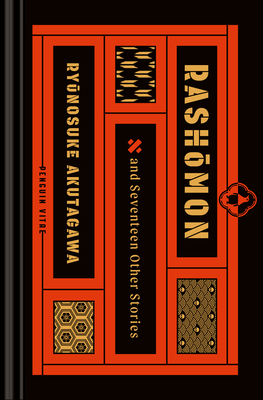
Rashōmon and Seventeen Other Stories

Ryunosuke Akutagawa

£9.50
New •

A collectible hardcover edition of the best stories by the father of the Japanese short story—including the two that inspired Kurosawa's classic samurai film about the subjectivity of truth—featuring an introduction by Haruki MurakamiA Penguin Vitae EditionRyūnosuke Akutagawa is one of Japan's foremost stylists—a modernist master whose short stories are marked by highly original imagery, cynicism, beauty, and wild humor. "Rashōmon" and "In a Bamboo Grove" inspired Akira Kurosawa's magnificent film and depict a past in which morality is turned upside down, while tales such as "The Nose," "O-Gin" and "Loyalty" paint a rich and imaginative picture of a medieval Japan peopled by Shoguns and priests, vagrants and peasants. And in later works such as "Death Register," "The Life of a Stupid Man," and "Spinning Gears," Akutagawa drew from his own life to devastating effect, revealing his intense melancholy and terror of madness in exquisitely moving impressionistic stories.Penguin Vitae—loosely translated as “Penguin of one’s life”—is a deluxe hardcover series from Penguin Classics celebrating a dynamic and diverse landscape of classic fiction and nonfiction from seventy-five years of classics publishing. Penguin Vitae provides readers with beautifully designed classics that have shaped the course of their lives, and welcomes new readers to discover these literary gifts of personal inspiration, intellectual engagement, and creative originality.

ISBN 9780143137887
Publisher Penguin Vitae
Translated by Jay Rubin

We ship worldwide. For full shipping rates, delivery times and returns information, please visit our Shipping & Returns page

New copy in perfect condition.

Ryunosuke Akutagawa

Ryunosuke Akutagawa was born in Tokyo in 1892 and was adopted by his maternal uncle shortly after birth — his mother having become mentally ill — taking the name Akutagawa from his adoptive family. He grew up in a household that was cultured, bookish, and engaged with both Japanese classical literature and Western modernism, and this dual inheritance shaped everything he wrote. He studied English literature at Tokyo Imperial University, where he began publishing fiction that attracted attention while he was still a student, and graduated in 1916 with a reputation already established.

His career was extraordinarily concentrated — he published most of his significant work in a period of about fifteen years before his death at thirty-five — and within that concentrated output produced a body of short fiction that is technically precise, psychologically penetrating, and formally adventurous in ways that remained influential for the entire subsequent history of Japanese literature. He worked across multiple modes: historical fiction set in the Heian period, contemporary psychological studies, satirical pieces, and experimental works that anticipate much later developments in postmodern fiction.

Rashōmon, published in 1915 and his most internationally famous single story, is set in a ruined city gate during a period of social collapse, and follows a servant displaced from his employment who steals from a woman stripping corpses of their clothes. The story poses the question of morality under survival pressure with a logical economy that is characteristic of Akutagawa at his best: the situation is constructed to make the question unavoidable, and the conclusion offers no comfortable resolution. In a Bamboo Grove, published in 1922, presents seven accounts of a single event — the death of a samurai, the assault of his wife — each from a different witness or participant, no two versions consistent, the truth systematically unavailable. Akira Kurosawa's 1950 film Rashōmon combines both stories and made them globally famous.

His final work, Cogwheels, written in the months before his death, is an autobiographical fragment of extraordinary intensity: a record of the hallucinations, paranoid episodes, and terror that preceded his suicide in 1927. He died of a deliberate overdose of Veronal at thirty-five, leaving a letter describing 'a vague unease about my future.' The Akutagawa Prize, established in 1935 and awarded twice yearly to the best short fiction by a new or emerging writer, is the most prestigious debut prize in Japanese literature and keeps his name perpetually attached to the Japanese literary tradition he helped define.

Read more from Ryunosuke Akutagawa

Readers Also Loved

More stories with a similar mood.