Ryu Murakami was born in 1952 in Sasebo, a port city in Nagasaki Prefecture where a major American naval base is located — a geographical fact that permeates his debut novel so thoroughly it might be considered its setting rather than its background. Unrelated to Haruki Murakami despite sharing a surname, Ryu Murakami represents an entirely different strand of Japanese literary fiction: where Haruki's work is melancholy and surreal, Ryu's is visceral, political, and explicitly confrontational. They are often mentioned together in discussions of Japanese literature's international profile, and the contrast between them is illuminating about the range of that literature.
Almost Transparent Blue, published in 1976, won the Akutagawa Prize and announced a radically new voice in Japanese fiction. Set in a community of young Japanese people living near the American base in Sasebo and spending their time in a haze of sex, drugs, and rock music, the novel is both an anthropological document of a specific subculture and a literary work of genuine ambition — raw, visceral, and structurally more sophisticated than its surface energy suggests. The presence of the American military, and the complex relationships — economic, sexual, cultural — that form around the base, gives the novel a political dimension that sits alongside its more immediate provocations.
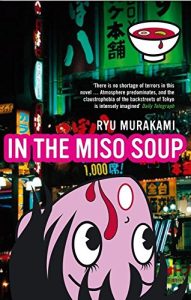
Coin Locker Babies, his ambitious second novel published in 1980, is his most formally impressive work: a story about two babies abandoned in coin lockers at a train station who grow up to pursue different forms of violence against the society that discarded them. The novel is epic in scale, hallucinatory in atmosphere, and uncompromising in its treatment of the damage that deprivation inflicts on children and the forms it takes in adults. In the Miso Soup, published in 1997, is more contained: a Japanese man who works as a guide to the sex industry districts of Tokyo finds himself in the company of an American tourist who may be a serial killer. The escalating horror is rendered with precision and without the moral protection of distance.
Murakami has also worked extensively in film, directing Audition from his own source material in what became one of the most discussed Japanese horror films of its era. His fiction consistently refuses the consolations of aesthetic distance, insisting that the reader remain uncomfortable in the presence of what it depicts.