
Back to books

Choose your copy

Current selection
Available
Currently unavailable
New
Pre Loved
Special

Your Utopia

Bora Chung

£14.00
New

By the internationally acclaimed author of Cursed Bunny, in another thrilling translation from the Korean by Anton Hur, Your Utopia is full of tales of loss and discovery, idealism and dystopia, death and immortality. "Nothing concentrates the mind like Chung’s terrors, which will shrivel you to a bouillon cube of your most primal instincts" (Vulture), yet these stories are suffused with Chung’s inimitable wry humour and surprisingly tender moments, too—often between unexpected subjects.

In "The Center for Immortality Research", a low-level employee runs herself ragged planning a fancy gala for donors, only to be blamed for a crime she witnessed during the event, under the noses of the mysterious celebrity benefactors hoping to live forever. But she can’t be fired—no one can.

In "One More Kiss, Dear", a tender, one-sided love blooms in the AI elevator of an apartment complex; as in, the elevator develops a profound affection for one of the residents.

In "Seeds", we see the final frontier of capitalism’s destruction of the planet and the GMO companies who rule the agricultural industry in this bleak future, but nature has ways of creeping back to life.

Chung’s writing is "haunting, funny, gross, terrifying—and yet when we reach the end, we just want more" (Alexander Chee). If you haven’t yet experienced the fruits of this singular imagination, Your Utopia is waiting.

ISBN 9781920000000
Publisher Honford Star
Translated by Anton Hur

We ship worldwide. For full shipping rates, delivery times and returns information, please visit our Shipping & Returns page

New copy in perfect condition.

Bora Chung

Bora Chung is a South Korean writer and academic who teaches Russian language and literature at Yonsei University in Seoul. Her path to international literary recognition was unusual: she published short fiction in Korean genre and literary magazines for years without attracting significant attention outside Korea, before the translation of her collection Cursed Bunny by Anton Hur brought her work to an English-speaking audience that was entirely unprepared for it. The International Booker Prize longlist in 2022 was, for many readers, their first encounter with both Chung and the particular tradition of Korean fantastical fiction she represents.

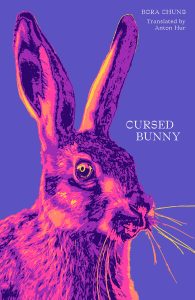
Cursed Bunny collects ten stories that resist easy genre classification. They draw on folklore — particularly Korean and Russian folk traditions, the latter reflecting Chung's academic expertise — on science fiction, on horror, and on the feminist body horror tradition, combining these into something that is none of them precisely but uses all of their tools. 'Cursed Bunny,' the title story, features a luminous rabbit-lamp used as an instrument of family revenge. 'The Head,' one of the collection's most disturbing works, depicts a woman discovering a disembodied head in her apartment that takes up residence and refuses to leave. 'The Embodiment' — a corporate satire in which male executives are given the experience of pregnancy — is darkly funny in its unflinching specificity.

What unifies these diverse modes is a consistent political sensibility and a particular quality of tone: cool, precise, and deadpan in a way that makes the horror more effective by refusing to signal it conventionally. Chung does not build toward the frightening moment in the manner of conventional horror fiction. She presents the disturbing thing matter-of-factly, as if it requires no special framing, and allows the reader to recognize their own discomfort without the text helping them manage it. This technique is related to, but distinct from, the magic realism tradition — it is less interested in wonder than in the social and political systems that produce suffering, and the fantastic elements are tools for making those systems visible.

Her academic work on Russian literature has contributed to her fiction in ways she has discussed: the Russian absurdist tradition, from Gogol through Bulgakov and Kharms, is visible in Chung's dark comedy, and her translation practice — which has brought Russian literary works into Korean — has given her an unusually sophisticated understanding of how cultural materials travel and transform across linguistic borders. A second collection has been anticipated by her international readership with considerable excitement.

Read more from Bora Chung

Readers Also Loved

More stories with a similar mood.