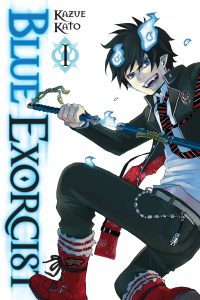
Kazue Kato is a Japanese manga artist whose major work, Blue Exorcist (Ao no Exorcist), began serialization in Jump Square magazine in 2009 and has continued since, constituting one of the longest-running and most consistent manga series currently in publication. Born in Miyagi Prefecture and having studied art formally before entering the manga industry, Kato developed both the visual sophistication and the narrative patience that sustained serialization requires.
Blue Exorcist is set in a world where demons exist in a parallel realm called Gehenna and occasionally cross into the human world of Assiah, where they must possess a human body or object to manifest. The Church of the True Cross trains exorcists to combat these crossings. Its protagonist, Rin Okumura, discovers on the night of a demonic attack that he is the son of Satan — the most powerful demon, who seeks to possess Rin's body and use him as a vessel to enter Assiah. Rin's decision to become an exorcist to fight his own father, rather than to serve him, provides the series' central dramatic situation and its central character tension: a boy who is, by nature and inheritance, the thing he is training to fight.
Kato's construction of the exorcist mythology is one of the series' particular strengths: the history of the Church, the relationships between different exorcist factions, the hierarchy of demons and their specific powers are developed with the consistency and internal coherence of well-conceived world-building. The series' tonal range is also notable — it moves between comedy (Rin's hapless attempts to be a competent student) and genuine darkness (the implications of his heritage and the history of the Church) without either register undermining the other.
The anime adaptations — the first series in 2011 (which diverged from the manga), and the second in 2017-2023 (which followed it faithfully) — received different responses reflecting the very different experiences of watching an adaptation that invents its own ending versus one that renders the source material. The second adaptation's reception was considerably warmer, validating the manga's narrative choices and introducing new readers to Kato's work.